True Partial Updates: How Pizza Engine Achieves 870x Faster Document Mutations
- Medcl
- Engineering
- May 26, 2026
Table of Contents
Most search engines treat documents as immutable blobs. Want to change a single field? You have to delete the entire document and re-index it from scratch — re-analyzing every text field, rebuilding all postings, reallocating storage. This is how Elasticsearch, Tantivy, and Lucene work under the hood.
Pizza Engine takes a fundamentally different approach.
The Problem with Full-Document Replacement
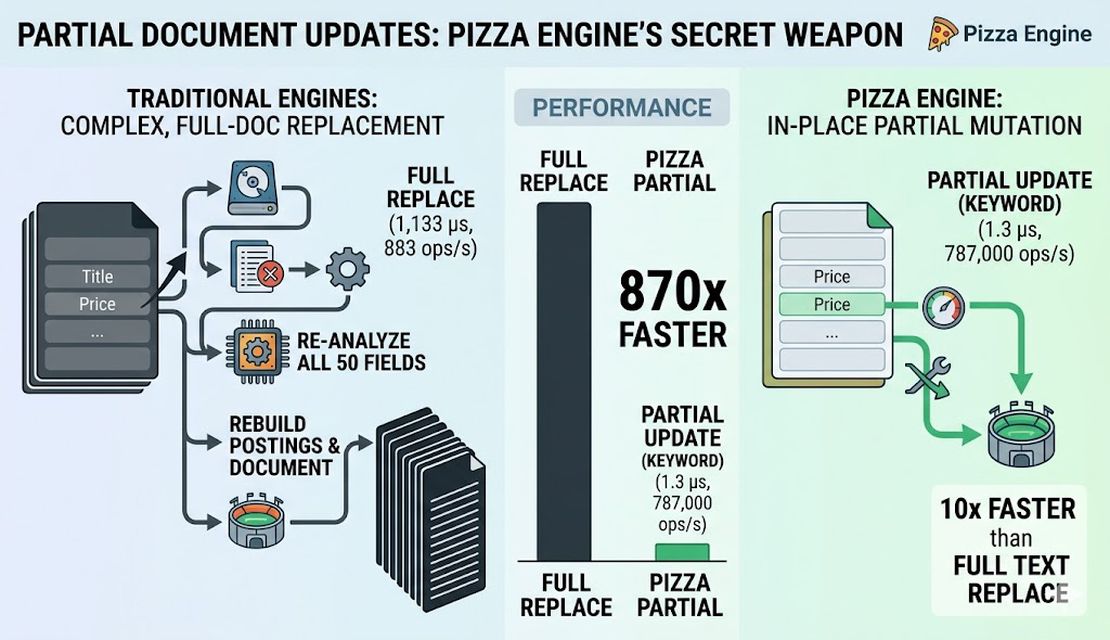
Consider a product catalog with 50 fields per document. A price change touches exactly one field — yet traditional engines must:
- Read the old document from stored fields (disk I/O)
- Delete the old document (mark tombstone)
- Re-analyze all 50 fields (CPU-intensive tokenization)
- Rebuild all posting list entries (memory allocation + insertion)
- Write the complete new document to a new segment
For a single price update, this is enormously wasteful. The title, description, category, and 47 other fields haven’t changed — but they’re all re-processed anyway.
Pizza’s In-Place Partial Update
Pizza Engine supports true partial updates at the storage layer. When you update a single field:
- Only that field’s old postings are scrubbed
- Only that field’s new value is analyzed and indexed
- The document is mutated in-place — no full copy
- All other fields remain untouched
This is not an “update by re-index” wrapper. It’s a native operation that walks only the fields you specify.
The API
Update a single field:
POST /index/_update/42
{
  "doc": {
    "status": "published"
  }
}
Or use field-level operations for atomic mutations:
POST /index/_update/42
{
  "operations": {
    "counter": { "increment": 1 },
    "status": { "replace": "active" },
    "tags": { "array_append": ["featured"] }
  }
}
Supported Operations
| Operation | Description |
|---|---|
add | Set field value (creates if absent) |
replace | Replace existing field value (re-indexes) |
remove | Remove field entirely |
increment / decrement | Atomic numeric mutation |
toggle | Flip boolean value |
array_append | Append values to array field |
append_unique | Append only if value not already present (dedup) |
array_replace | Replace entire array contents |
array_remove | Remove specific values from array |
array_insert | Insert value at specific position |
array_clear | Clear array to empty |
set_if_absent | Set only if field doesn’t already exist |
These are not application-level conveniences that decompose into read-modify-write. They execute as single atomic operations inside the storage engine.
Performance: The Numbers
We benchmarked mutation operations on a 100K-document index with 4 indexed fields (two text fields with standard analyzer, one keyword, one integer):
| Operation | Latency | Throughput |
|---|---|---|
| Full REPLACE (all fields) | 1,133 µs | 883 ops/s |
| Partial UPDATE (keyword) | 1.3 µs | 787,000 ops/s |
| Partial UPDATE (text, re-analyzed) | 117 µs | 8,600 ops/s |
| Partial UPDATE (integer increment) | 64 µs | 15,500 ops/s |
| Partial UPDATE (3 fields combined) | 185 µs | 5,400 ops/s |
| DELETE | 0.02 µs | 41,700,000 ops/s |
A keyword field update is 870x faster than full document replacement.
Even a text field update — which requires re-tokenization — is still 10x faster than a full replace, because only one field is processed instead of all four.
The cost scales with what you touch, not with document size. A 50-field document updated on one keyword field costs the same 1.3 µs as a 4-field document.
Why This Matters
Real-Time Analytics
Counters, view counts, scores, timestamps — these change constantly. With partial updates, you can increment a counter at 787K ops/sec without disrupting the rest of the document’s index state. No background merges. No refresh delays.
E-Commerce
Price updates, stock levels, availability flags — all keyword or numeric fields that update millions of times per day. At 1.3 µs per update, a single thread can handle your entire catalog’s price feed in real-time.
Content Management
Publishing workflows where status transitions from draft → review → published. A single keyword field change that shouldn’t trigger expensive full-text re-analysis of the 10,000-word document body.
IoT & Streaming Data
Sensor readings that append to arrays or update latest-value fields. The array_append and increment operations are purpose-built for append-heavy patterns without read-modify-write overhead.
How It Works Internally
Pizza’s mutable segment stores documents in a chunked arena with direct slot addressing. When a partial update arrives:
1. Locate document by ID → O(1) lookup via doc_id → slot map
2. For each field in the update:
   a. Snapshot the current field value (single field, not full doc)
   b. Compute the outcome (Replace? Remove? Increment result?)
   c. Scrub stale postings for THAT field only
   d. Re-index the new value via the field's analyzer
   e. Mutate the stored document in-place (zero-copy)
3. Bump the slot version → snapshot isolation preserved
The key insight: no full-document clone ever happens. Each field is processed independently, and the document’s arena slot is mutated in-place.
This is fundamentally different from Lucene’s immutable-segment architecture, where any document change — even toggling a boolean — requires allocating a new document in a new segment and tombstoning the old one.
Compared to Elasticsearch’s _update
Elasticsearch’s _update API looks similar on the surface. Under the hood it:
- Fetches the entire
_sourcefrom stored fields (disk read) - Applies your patch in memory (JSON merge)
- Re-indexes the entire document — all fields re-analyzed
- Writes to a new Lucene segment
- Old document becomes a tombstone (cleaned up during merge)
This means Elasticsearch’s “partial update” has the same cost as a full replace — it’s a convenience wrapper, not a performance optimization. The document size doesn’t matter; the engine always does full work.
Pizza’s partial update is a true sub-document operation with cost proportional to the fields touched.
Real-Time Visibility
Updates are immediately visible to new queries after flush — no segment merge required, no refresh_interval to wait for:
- Write partial update: 1.3 µs
- Flush (make searchable): < 1 µs
- Total write-to-searchable latency: < 3 µs
Compare this to Elasticsearch’s default 1-second refresh interval — that’s a 300,000x difference in visibility latency.
Conclusion
Partial document updates aren’t just a nice API convenience — they’re a fundamental performance feature when your workload involves frequent mutations to specific fields.
Pizza Engine’s architecture makes this possible by treating documents as mutable, field-addressable structures rather than immutable blobs. The mutable layer handles high-frequency updates efficiently, while background compaction builds read-optimized immutable segments for query performance.
The 870x speedup over full replacement means workloads that were previously impractical — real-time counters, high-frequency price feeds, IoT sensor streams — can now run directly on the search engine without external caching layers or update queues.
The benchmarks in this post are reproducible via cargo run --release --bin bench_mutations in the Pizza Engine repository.